
Persian Santoor History and Origin: The Complete Story of Iran’s Ancient Hammered Dulcimer
What country is Santoor from?
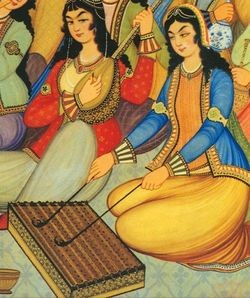
The presence of some similar instruments to Santoor all over the world makes it hard to identify the exact origin of it. According to Gifford (2001), Santur was first played by women in Iran before appearing in other countries such as Turkey and India. As we can see in the first written records, Santoor appeared in Persian history texts and poetry around the 10th century. Based on the stone carvings from Assyrians and Babylonians, the first signs of Santoor origin come from Iran. The findings show that Santur was played while hanging from the player’s neck.
According to Historians, the Iranian Santoor was the ancestor of the Harp, Yangqin, Harpsichord, Qanun, Cimbalom, and Hammered Dulcimers. There are several theories about the origin of Santur but it is mostly believed that the Iranian instrument is the predecessor to similar types. As a traditional instrument, it has a lifetime history in Iran since centuries ago. This article tries to give some information about this old Iranian musical instrument, its features, and the best players of it.
What is a Santoor?
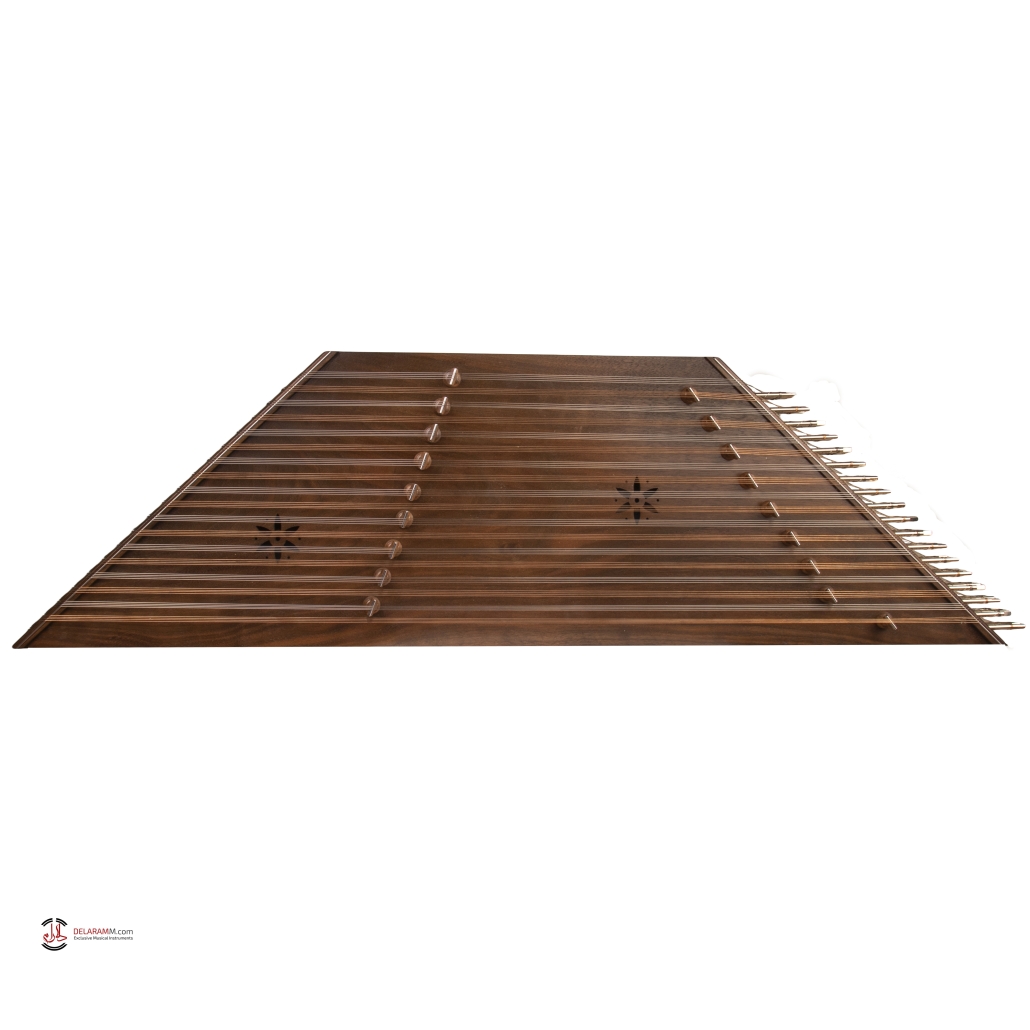
Santoor is an instrument with approximately 72 to 100 strings and a wooden board made of different types of woods such as walnut. All types of this instrument have two bridges on the left and right sides of the soundboard called ‘Kharak’ where the strings stretch. The Most common type has nine Kharak in each row that divides the instrument into four parts. Two flower-shaped holes on it play a major role in beautifying the sound.
Each Santoor needs a tuning tool and a set of “Mallets”. By having different types of Mallets you may have different sounds. The player holds the Mallets by thumb and the middle fingers. Like most other instruments, Santur also has some limitations for the player; however, the beautiful sound of the instrument absorbs everyone around. There are different techniques to play this instrument professionally. However, to play well you need to follow the below steps.
The Meaning of the Word Santoor
The origin of the word Santoor remains a subject of scholarly discussion. One popular theory suggests that it derives from the Persian words meaning “hundred strings,” referring to the instrument’s large number of strings.
Another theory connects the word to the Greek term Psalterion, an ancient string instrument that influenced many zither-like instruments throughout the Mediterranean and Middle East.
Regardless of its exact linguistic origin, the name Santoor has been associated with hammered string instruments for centuries across Persia and neighboring regions.
Ancient Origins of the Persian Santoor
The history of the Santoor may date back more than 2,500 years. Many researchers believe the instrument evolved from ancient stringed instruments used in Mesopotamia, including the civilizations of Assyria and Babylon.
Archaeological evidence from ancient Mesopotamia includes stone carvings depicting musicians playing trapezoidal string instruments. Some of these carvings date to around 669 BCE and are often cited as the earliest visual evidence of instruments resembling the modern Santoor.
Although these ancient instruments were not identical to today’s Persian Santoor, they demonstrate that hammered or struck string instruments existed in the region long before the medieval period.
The Santoor in Ancient Persia
As Persian civilization flourished under various dynasties, music became an important part of court life, religious ceremonies, and cultural expression.
Historical accounts suggest that instruments similar to the Santoor were known during the Sasanian Empire (224–651 CE), a period often regarded as a golden age of Persian music. Although surviving evidence is limited, medieval scholars later referenced the Santoor when describing earlier Persian musical traditions.
These references indicate that the instrument had already become part of Persia’s musical heritage centuries before the modern era.
Medieval References to the Santoor
The earliest written mentions of the Santoor appear in medieval Arabic and Persian sources.
One of the most significant references comes from the 10th-century historian Al-Masudi, who mentioned the Santoor among instruments associated with Persian music. Later Persian manuscripts and miniature paintings also depict musicians performing on instruments that closely resemble the modern Santoor.
By the Timurid and Safavid periods, the Santoor had become a recognized instrument in Persian musical culture and appeared in artistic works throughout the region.why we believe that rhythmic patterns empower you more.
The Evolution of Santoor Construction
The Santoor has undergone significant changes over the centuries.
Early versions likely used gut strings and simpler bridge systems. As instrument-making techniques improved, builders introduced metal strings, stronger wooden soundboards, and more refined tuning mechanisms.
Modern Persian Santoors typically feature:
- Trapezoidal walnut construction
- 72 metal strings
- 18 movable bridges
- Lightweight wooden mezrabs
- A tuning system suitable for Persian dastgah music
These innovations improved both the instrument’s tonal quality and its musical flexibility.
How does it sound?
Santoor is considered both a percussion and string instrument. In this case, it is similar to piano and chordophone because, like both of them, Santoor produces sound when the strings are struck with a hammer. The strings are struck with two wooden mallets called “Mezrab”, giving it a unique sound. While playing it, listeners reach a calm and meditative state that fills their souls with joy.
Santoor was commonly used as the background sound for Sufi music and very rarely for solo performances. With the efforts of professional players, devoting their life to mastering the playing techniques over time, Santoor has reached a level of sublimation no one can deny or ignore. If you are seeking joy alongside pleasure you may need to listen to such instruments especially played by those mastering the instrument’s techniques and harmonies.
How the Santoor Spread Beyond Persia
The influence of the Persian Santoor extended far beyond Iran’s borders.
As Persian culture spread through trade routes, empires, and cultural exchange, variations of the instrument appeared across Asia and Europe.
Notable relatives of the Persian Santoor include:
Kashmiri Santoor (India)
The Kashmiri Santoor developed from Persian influences and became an important instrument in Indian classical music. Modern Indian Santoors often feature around 100 strings and a larger playing range.
Iraqi Santur
The Iraqi Santur is used in Arabic maqam music and features a different tuning system designed for Arabic musical traditions.
Greek Santouri
The Greek Santouri emerged through Ottoman cultural influence and remains popular in Greek folk music today.
Chinese Yangqin
The Yangqin is believed to have originated from Middle Eastern hammered dulcimers introduced to China through trade routes during the Ming and Qing dynasties.
Famous Persian Santoor Masters
Several musicians played a crucial role in preserving and developing the Persian Santoor.
Faramarz Payvar is widely regarded as one of the most influential Santoor players of the 20th century. His teaching methods and compositions helped standardize modern Santoor technique.
Other important masters include:
- Parviz Meshkatian
- Majid Kiani
- Manouchehr Sadeghi
Their contributions ensured the survival and continued growth of the instrument in contemporary music.
The Persian Santoor Today.
Conclusion
In this article, we have tried to give as much information as possible about the origin of Santoor, its physical characteristics, different basic techniques, and the most famous contemporary Santoor players. However, if you are interested in learning more about this instrument and its special features, you can watch videos and read more articles about it. Although Santur seems easy to play, even controlling the mallets between your thumb and finger is truly a difficult technique.
FAQ
The Persian Santoor is a traditional Iranian hammered dulcimer with a trapezoidal wooden body and multiple metal strings. It is played using two lightweight wooden mallets called mezrabs and is one of the most important instruments in Persian classical music.
Most historians believe the Santoor originated in ancient Persia and evolved from earlier string instruments used in Mesopotamia and the Near East. The instrument has been part of Persian musical culture for many centuries.
The Santoor’s ancestry may date back more than 2,500 years. Ancient Assyrian and Babylonian carvings depicting similar string instruments suggest that its predecessors existed as early as the 7th century BCE.
A standard Persian Santoor typically has 72 strings arranged in groups of four across 18 bridges. These strings are struck with mezrabs to produce different notes and tonal colors.
The Persian Santoor usually has 72 strings and is designed for Persian Dastgah music, while the Indian Santoor generally has around 90 to 100 strings and is adapted for Hindustani classical music and ragas.
The Santoor is considered moderately challenging for beginners. Basic melodies can be learned relatively quickly, but mastering tuning, hand coordination, ornamentation, and Persian classical repertoire requires years of dedicated practice.